

Rolfing® Structural Integration in Nyon, La Côte Region
What is Rolfing® Structural Integration (S.I.)?
Rolfing S.I. is a method of connective tissue (fascia)* manipulation and movement education. It aims to balance the body so that it can deal more efficiently with the downward force of gravity. The restored balance allows the body to relax and heal more completely.
Rolfers® work to affect the weblike connective tissue known as fascia. With its strong yet elastic property, fascia provides form and support for the body as it exists as a continuous interconnected network of tissue throughout. The muscles, bones and other structures organize and suspend themselves around this web. By addressing the form of the body through manipulation of the fascia, Rolfers address its function.
*Connective tissue is the thin membrane that surrounds individual muscle fibres, connects muscle to bone, forms tendons and ligaments and is sometimes referred to as ‘the organ of form’.
What are the benefits of Rolfing?
Rolfing is for everyone!
Who is Dr. Ida Pauline Rolf?
Rolfing is named after the American biochemist Ida Rolf, PHD, who developed the method in the 1950’s.
Throughout her life, she studied osteopathy, chiropractic medicine, yoga and the Alexander Technique. However, her main breakthrough was discovering that she could achieve changes to a patient’s posture and structure by manipulating the body’s myofascial system. The main goal of this was to organize a person’s body structure in relation to gravity.
The method was originally called Postural Release, and then Structural Integration. In 1971 she founded the Guild for Structural Integration, which became the Rolf Institute of Structural Integration. Eventually, the name “Rolfing®” stuck as the trade name.

« Form and function are a unity, two sides of one coin. In order to enhance function, appropriate form must exist or be created. »
Dr. Ida P. Rolf
What is “The Ten Series™"?
The 10 series is the recommended format for Rolfing although individual sessions and miniseries of three sessions are possible.
As a series of ten sessions, each session builds off from the previous one. Ida Rolf described it as one long session performed in ten sittings.
The sequence is essential for optimising the body’s ability to provide support. Various manual touch techniques are used to gently stretch, lengthen, hydrate and redirect the fascia into a place of greater efficiency.
Sessions 1-3
In the first three sessions we look at how free the breath is within the body and the potential it has to expand and support your skeletal and muscular structures. The work is performed both laying on a table and seated.
Sessions 4-7
These sessions look at the core. Here we dive deeper to bring support to the legs, pelvis, thorax, neck, and cranium. Many people describe these hours as the most intense both physically and emotionally, but the sensations may take longer to unravel as opposed to the first 3 sessions.
Sessions 8-10
In the final sessions we focus on integrating the lessons from the previous sessions to create a cohesive and unified body. These sessions are also focused on closure and giving you a sense of ownership of your new integrated body.
What to wear during a Rolfing session?
Comfortable underwear or a bikini for ladies and boxer shorts for men. Nothing tight. A blanket will be available.
What does a Rolfing session look like?
Rolfing usually feels like a slow, deep and intentional pressure. The sensation can be localised, or it can feel like the contact is affecting your whole body and system. Rolfing should never hurt (however discomfort is possible), and sensations may feel intense but never unbearable.
Many experience moments where the pressure feels as good as the deep stretch of a very tight muscle. You are likely to feel the release of long-held tension.
Is Rolfing comparable to a massage?
Rolfing is often mistakenly associated with massage. Massage, while therapeutic and relaxing, does not provide permanent changes in your body. While you may ‘zone out’ during a massage, a Rolfing session asks you to be an active participant.
This creates a dynamic and continuous conversation between both the Rolfer and the person being rolfed. This will allow you to gain heightened awareness of your body as it becomes aligned and integrated.
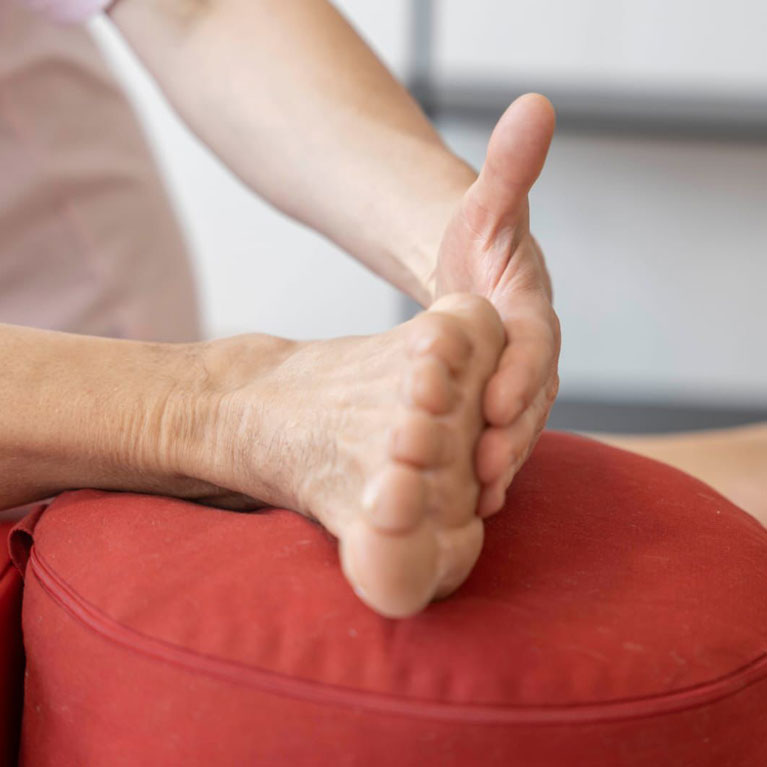
" Your body gets the notion when your feet can make the motion"
Everybody, lyrics by Madonna
Alison
Opening hours: 7:30 am. to 7:00 pm.
Monday to Friday
Rue de la Combe, 23
(Jerome Divorne physiotherapy clinic)
1260 - Nyon
Car Park options:
Shopping Center "La Combe"
(a two minute walk away from the clinic. First hour of parking is free of charge)
Perdtemps Car Park
(a five minute walk away from the clinic. First hour of parking is free of charge)
The main train station CFF is also a very short walk away.
WhatsApp: + 41 79 307 68 73


_1.jpg?v=1k1f9dj)
.jpg?v=1k1f9dj)